
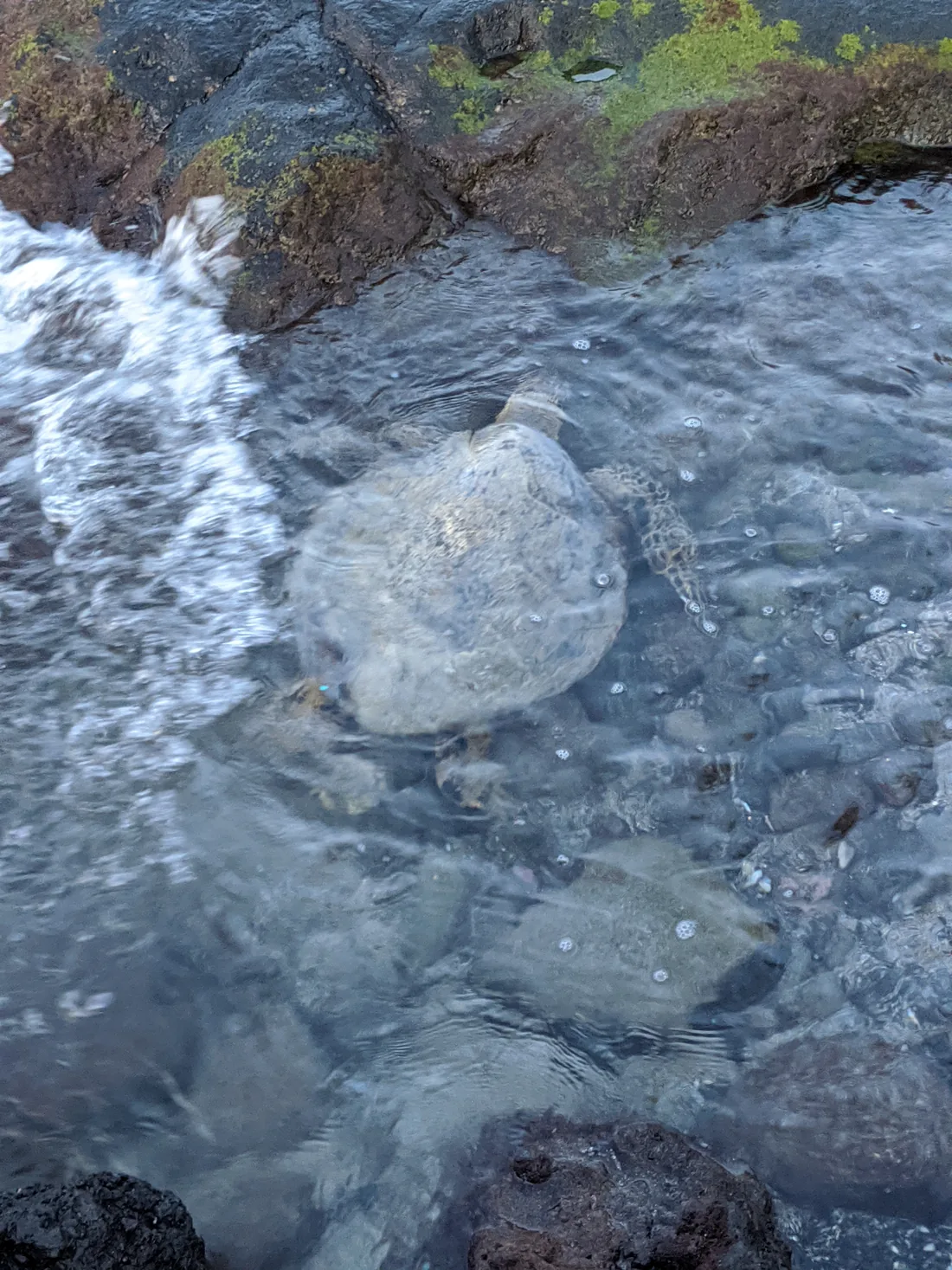
A honu in the shallows along the Big Island's lava-rock coast. Honu are protected, and NOAA recommends staying at least 10 feet away.
It's the perfect Big Island day on paper. A two-tank morning dive off the Kona coast, lunch in town, then a drive up Maunakea to watch the sunset above the clouds. Plenty of visitors plan exactly that.
It's also one of the riskiest things a diver can do on this island. The same nitrogen that makes airlines ask divers to wait before flying home doesn't care whether you go up in a plane or a rental car. And on the Big Island, almost every road off the coast goes up.
Here's what divers should know before they build the itinerary, and the easy fix: flip the order.
Why altitude matters after a dive
Every dive loads your body with extra nitrogen. On the surface it leaves slowly, over hours. Go up in elevation before it's cleared and the lower air pressure can pull it out of solution too fast, the same way bubbles appear when you open a soda. That's decompression sickness, "the bends."
Most divers know the rule about flying. Fewer realize it applies to driving too. Divers Alert Network (DAN), the diving safety organization behind the flying-after-diving research, bases its guidelines on altitudes between 2,000 and 8,000 feet, which is the range a pressurized airliner cabin sits in. A mountain road puts you there as surely as a 737 does.
The waiting times
DAN's minimum surface intervals, for divers with no symptoms, are:
- One no-decompression dive: wait at least 12 hours.
- Multiple dives in a day, or several days of diving: wait at least 18 hours.
- Dives that required decompression stops: wait at least 24 hours.
Those are minimums, not targets. DAN notes that longer intervals lower the risk further. And a typical dive vacation, two tanks a day for several days, lands squarely in the 18-hour category.
How high the Big Island goes
Here's the part that catches people. The Kona and Kohala coasts sit at sea level, but the rest of the island climbs fast:
| Where | Elevation |
|---|---|
| Kona and Kohala Coast resorts | Sea level |
| Waimea | About 2,700 ft |
| Volcano and Kīlauea | About 4,000 ft |
| Saddle Road (Daniel K. Inouye Hwy), high point | 6,632 ft |
| Maunakea Visitor Information Station | 9,200 ft |
| Maunakea summit | 13,803 ft |
Look at the first few rows again. The Saddle Road shortcut from Kona to Hilo tops out at 6,632 feet. The northern route passes through Waimea, above 2,000 feet. The southern route climbs toward Volcano. There's no way to drive from the Kona side to the Hilo side without going above 2,000 feet.
Maunakea is its own category. The Visitor Information Station and the summit are both above the 8,000-foot ceiling the flying guidelines were built on, and a car gets you there in an hour or two, far faster than your body can off-gas. PADI advises waiting at least 24 hours after diving before mountain trips, and longer after several days of diving.
The fix: mountain first, dive last
You don't have to choose between the reef and the mountain. The fix is putting them in the right order.
- Do the high-elevation days first. Maunakea stargazing, Hawaiʻi Volcanoes National Park, the drive to Hilo, a night in Volcano or Waimea. Climbing before you dive doesn't carry the same risk.
- Then settle on the Kona or Kohala side for the diving and stay near sea level: beaches, snorkeling, Kailua-Kona, the resorts.
- Put the last dive at least 18 hours before your flight home, and more if you can. Inter-island hops count as flights too.
- If you're splitting the trip between both sides of the island, dive on the Hilo side last or build in a full no-dive day before you cross.
Our youngest daughter dove the Kohala Coast with us back in 2014, and she loved it. The sea-level side of the island has plenty to fill the days around a dive: beaches, snorkeling, lava-rock coastline, and honu (Hawaiian green sea turtles) resting in the shallows.
What the bends can look like
Symptoms can show up hours after a dive, which is why they get mistaken for jet lag or a long day in the sun: unusual fatigue, joint or limb pain, tingling or numbness, dizziness, or a skin rash. If you notice any of them after diving, especially after going up in elevation, treat it as a diving injury. Get emergency oxygen from the dive operator if you're still with them, call 911, and call the DAN Emergency Hotline at +1-919-684-9111, which answers 24 hours a day. Don't wait to see if it passes.
The bigger picture
The Big Island is one of the few places where a world-class dive and a 13,000-foot mountain are a couple of hours apart. That's what makes it special, and it's also the trap. Nobody is going to stop you at the Maunakea Access Road to ask when your last dive was. Plan the order before you book, and you get both.
Have you ever had to rearrange a trip around a dive? Tell us how you planned it in the comments.
Sources: Divers Alert Network flying-after-diving guidelines; PADI; University of Hawaiʻi Maunakea Visitor Information Station. This post is general travel information, not medical advice. Talk to your dive operator and follow DAN's guidance for your own dive profile.


 Posts
Posts


No comments:
Post a Comment